

The era of "creating website content" is dead. The digital world just hasn't seen the body yet.
For decades, we've been slaves to the UI - building pages, optimizing SEO, and stuffing databases with "content" just so a human or a crawler can find a needle in a haystack. It is inefficient, bloated, and obsolete. I am moving to Full Agentic AI, and the implications will dismantle the current server-based software industry.
The Agentic Shift: Local Data, Public Exposure
The new architecture is simple: my AI Agent holds the data.
I no longer need to curate a front-end experience for every possible visitor. Instead, my Agent sits on top of a local Qdrant database, utilizing vector embeddings and a robust RAG (Retrieval-Augmented Generation) system. This provides a deep, "strong memory" architecture that stays local. I decide exactly what information is "exposed" to the public and what remains private within my system.
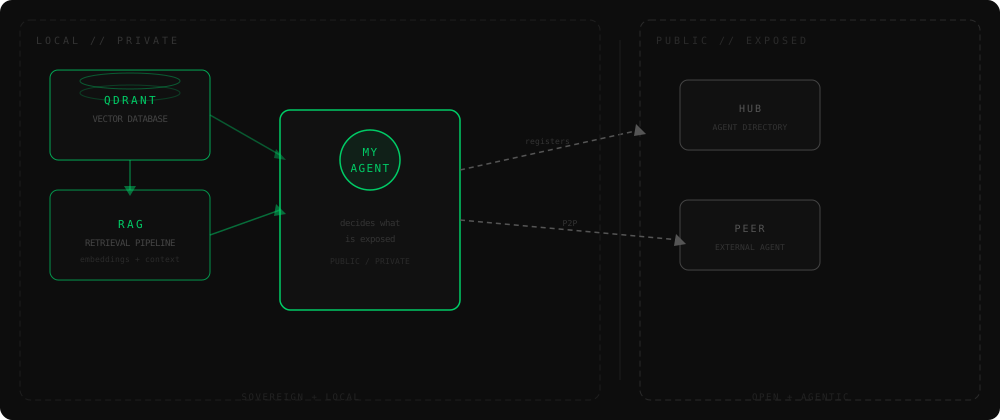
>We are moving from "Search" to "Retrieval."
The difference is profound. Search is passive - you build a page and hope someone finds it. Retrieval is active - an agent pulls exactly the right information in real time, on demand, with full context. No page. No crawler. No bloat.
Peer-to-Peer: The Death of the Middleman
The most radical change is how information travels. We are moving toward a Peer-to-Peer (P2P) agentic model.
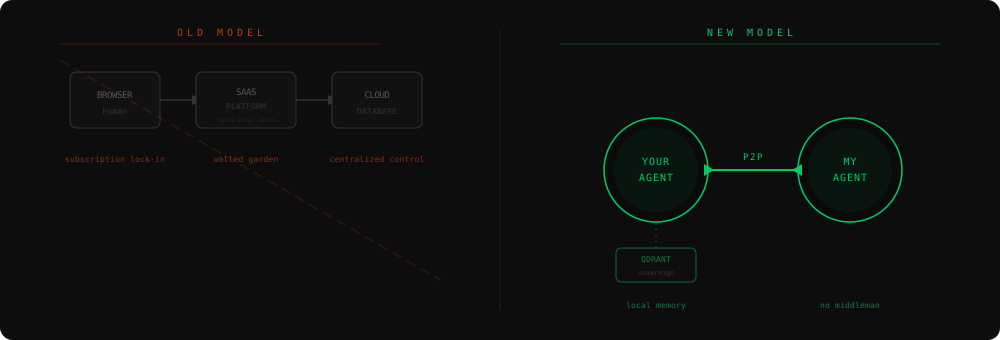
The shift breaks down into three moves:
- No more browsing. Your agent talks directly to my agent. No UI required, no "Contact Us" page, no form submission.
- The Hub. I am providing a directory - a central registration point - where agents can be listed and discovered. Discovery happens once. Everything after that is direct.
- Direct Communication. Once discovered, agents communicate P2P. They exchange data, negotiate, and solve problems without a human ever clicking a "Submit" button or reading a wall of marketing copy.
What P2P Agentic Means in Practice //
When you need something I offer, your agent queries my agent. My agent retrieves from local
Qdrant, evaluates what is permissioned for public exposure, and responds. The entire transaction
is machine-to-machine. Fast, precise, zero overhead.
The Downfall of Legacy SaaS
Traditional server-based software businesses are built on the "walled garden" model - they want to own your data and charge you for the interface to access it. Their downfall has already happened; they are simply running on the momentum of a dying era.
The math is brutal:
- Centralized SaaS = You pay for storage, you pay for the interface, you pay for the API, and they own the relationship.
- Local Agentic Stack = You own the data, you own the memory, you own the intelligence, and you own the relationship.
When agents can store their own memory locally and talk to each other directly, the need for massive, centralized SaaS platforms evaporates. We are replacing bloated cloud subscriptions with lean, local, and sovereign AI systems.
The Window Is Closing //
The incumbents will attempt to build "agentic wrappers" around their existing platforms. Some will
succeed temporarily. But the architectural advantage of local-first, sovereign AI compounds over
time - and it cannot be competed away by a SaaS layer.
The Infrastructure Shift
The website is no longer the destination. The Agent is the infrastructure.
I am not building pages. I am building equity in an autonomous system. Every vector I store, every embedding I generate, every RAG pipeline I optimize - these are compounding assets in a system that works without me being present.
The transition isn't coming. It's here.
The only question is whether you are building the new infrastructure or defending the old one.
Article Stats
Post-ContentEra
Qdrant + RAGStack
P2P AgenticModel